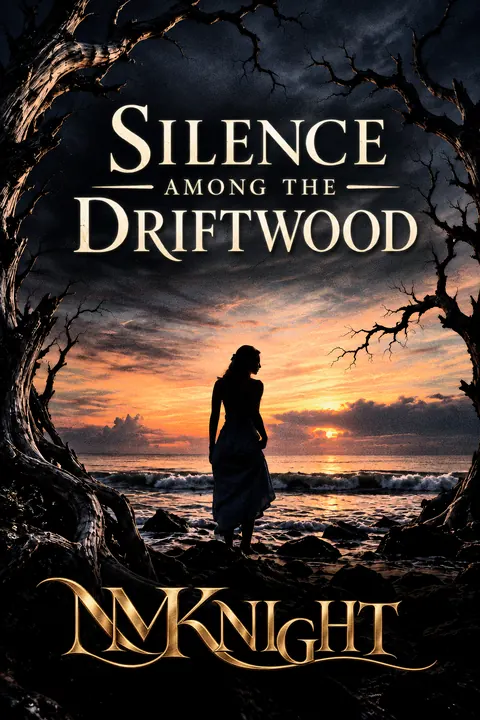
Silence Among the Driftwood
Chapter One
The whole first chapter, free. About ten minutes to read.
Coastal Georgia is a place where the earth and water wage an old, quiet war, the marshes encroaching ever closer to the live oaks that stand guard at the edge of their world. Few people know Georgia has a coastline at all, and because of that it has kept a wild kind of beauty, the sort that only shows itself to those who wade in deep enough to find it.
The egrets, white cousins of the heron, stand statue-still in the brown shallows, their feathers aflame in the tangerine glow of dusk as they hunt between the sawgrass, which looks soft when the breeze pushes through it, though every blade is edged with fine teeth that’ll draw blood if you rub it the wrong way. Kingfishers hover like hummingbirds, orange and blue, then fold their wings and drop, disappearing beneath the surface only to rise again, shimmering, with their catch.
At night the lightning bugs flicker like twinkling stars, weaving their glow through the needles of the longleaf pines. When the rain falls on the marsh like a fisherman’s net, the air hums with the chanting of frogs. On nights like that, Georgia is a slow dream more than a place, hidden in the pulse of a modern world around it moving too fast.
Along its coast stretch a total of fifteen barrier islands, pearls strung across the edge of the Atlantic, and no two of them alike.
There’s St. Catherines, home to a troop of wild ring-tailed lemurs, the only place on Earth they live wild outside of Madagascar. They leap through the branches with striped tails and strange curious eyes, like they wandered in from a far off place.
Then there’s Cumberland Island, where hundreds of wild horses roam free, descended from mounts the Spanish conquistadors left behind. They move through the dunes and the marsh grass like they’ve always called the island home.
Between these two sit St. Simons and Jekyll Island. St. Simons is where southern decadence drips like honey from every grand estate and moss-laden oak, and beside it lies Sea Island, a billionaire’s playground where movie stars and magnates go to be rich in private.
Though long before the money came, St. Simons gave the country something else. In the 1790s, when the young nation needed a navy, shipwrights came south for the live oaks, whose crooked branches already grew in the shape of a ship’s ribs. They felled them at Gascoigne Bluff and hauled the timbers north to Boston, where they became the bones of warships, one being the USS Constitution.
In the summer of 1812 she met a British frigate in open water, and the sailors watched the enemy’s cannonballs strike her hull and bounce off into the sea. One of them said that her sides were made of iron, and the name stuck. Old Ironsides. She never lost a fight, and she floats in Boston Harbor to this day, the oldest wooden warship still afloat anywhere in the world, held together by Georgia live oak.
Jekyll Island keeps an older kind of time, its forests dark and tangled, passed over by the money that found the other island. And yet at the old Jekyll Island Club, America’s wealthiest men once gathered in secret and sketched out the Federal Reserve beneath a canopy of live oaks.
Across the river is Brunswick, Georgia, a forgotten place, hidden behind worn highways and cracked country roads that the modern world abandoned long ago. Folks who live there will tell you old stories, one being that the devil himself came hunting souls and left empty-handed, run off by the heat, the mosquitoes, and the sour breath of the paper mill.
The sea takes what it can from this coast.
But every now and then, it gives something back.
This time it gave only a pale shape among the driftwood, hair braided through the roots of a dead oak like seaweed. Then the tide pulled back, and the shape had a face.
It was Jannie Hope.
Fin — Brunswick, Georgia, August 1987
A boy came across one of those old southern stories on a Tuesday in August, in the torn-up ground where longleaf pines used to rule.
Fin Thigpen was twelve that summer, sunburnt across the nose and scratched up all over from chasing lizards through the saw palmettos behind his trailer park. The construction crews had been clearing the land next door for a month, apartments, the first of them already rising on the far side, and the longleaf pines had gone down tree by tree until only one was left standing: a live oak that had stood among them so long and grown so big it didn’t seem like a tree so much as a structure, its trunk was wide as a grain silo, ferns growing from the grooves of its bark, limbs flung out far enough to shade a baseball field.
The machines sat idle around it like a pack of hungry turkey vultures that didn’t know where to start, the crew went off to lunch to talk over a plan.
A sign at the road said the apartments would be called Live Oak Terrace, which was the kind of joke Glynn County was always making without knowing it, and under that, in the confident lettering of money, COOPER CONSTRUCTION. Fin was twelve. The name meant nothing to him yet.
As he walked by he noticed an old man stood beneath it, still as the tree itself.
“Mister,” Fin called, shading his eyes from the Georgia sun, “you oughtn’t stand so close. They’re fixin’ to bring it down.”
The old man turned slow, the way the tide turns. His beard moved in the breeze like the Spanish moss above him, and his eyes caught the light in a way that made Fin think of looking down a well. “I guess they are, huh, kid,” he said. The drawl was Georgia, slow as molasses off a spoon, but underneath it ran something else — salt, maybe, and distance.
“Why you lookin’ at it so sad? It’s just a tree.”
“Just a tree.” The old man chuckled, dry as fall leaves. “I planted her here myself,” he said with a wink. “She’s been growing here about six hundred years.”
Among the roots, in a hollow of stone worn smooth as a bowl, rainwater stood, and the old man dipped his open hand in it before he touched the tree. Then he laid a gnarled hand against the bark, gentle as you’d touch a sleeping animal, and the wind moved through the crown above them with a sound like the marsh breathing in its sleep, and Fin, twelve, with no way of knowing it yet, heard the first sound he would ever love.
Fin squinted up at him. “You look pretty old, mister. Real old. But you don’t look that old.”
“I do look old, don’t I kid?” A smile moved through the beard.
“Well, this is how old I was when I planted her here. What you see and what truly is, they ain’t always the same thing. You’ll learn that as you get older.” He knelt, pressing his palm flat against a root thick as Fin’s waist, as if feeling for a pulse. “Long time back, when I first came to these shores, I pulled a boy out of the marsh mud. Pluff mud’s like quicksand if you catch the wrong spot. It had him to the chest and it wanted the rest. He gave me an acorn as a thank-you, told me it was special. I tossed it away like a fool. Tossed it right here, matter of fact.” He looked up into the branches.
“Learned the truth of it later. Since the day she took root, I haven’t aged. Couldn’t die, even the times I wanted to. Seen the disappointment on a few men’s faces over that, I’ll tell ya.”
The machines started up somewhere behind them, and the old man’s eyes went up into the branches, weary.
“As long as she stands, so do I,” the old man said. “And when she falls—” he glanced at the half-built apartments beyond the dirt “—well. I reckon all that time she’s been holding back will finally come to collect.”
He dug into the pocket of his weathered trousers and brought out an acorn. Small and smooth, ordinary as any acorn Fin had ever seen. He held it like it was the last coal of a fire.
“What is it?” Fin asked, though he could see plain enough what it was.
“An acorn, from her. It grows a live oak just like this.” The old man turned it once in his fingers, and something moved behind the words like a fish under a dock. “Near as I can tell. It’s yours if you want it. You just got to do me one favor. When the time comes, and you’ll know it when it comes, you plant it. Once she takes root, her canopy will hold time off of you, same as this one did for me.”
Fin stared at the little acorn. “And I’ll never get older?”
“Not while it stands.” The old man’s voice went soft and grave at once. “But heed this. A life without time is a weighty thing to carry. It can be a gift or it can be a curse, and like most anything, I reckon, it’s all in how you carry it.”
“Well, I suppose I ought to wait till I can reach the cupboards without help.”
“I reckon you should, kid.”
“Why give it to me, though?”
The old man pressed it into the boy’s palm, and his smile went somewhere far off. “Well hell, there ain’t nobody else around. Might be the last thing I ever do. And you came stumbling by at just the right time. Maybe this will give the old girl another chance. Lord knows she doesn’t deserve to go like this.” He folded the boy’s fingers tighter over the seed.
“One day you’ll know what to do with it, kid.” Then he turned back to the oak.
Fin said goodbye and ran the whole way home, the acorn hot in his fist, certain he was carrying forever. His mother was at the kitchen counter chopping vegetables for stew when he burst through the screen door hollering about an old man and a magic acorn and living to be a thousand or more.
“What did I tell you about talking to strangers?” she said, but the smile gave her away, and she wiped her hands on the dish towel and bent down to look at the acorn with the seriousness the moment deserved. “Well. That’s a mighty important thing, then. You’d best keep it somewhere very, very safe.”
He tucked it into an old cigar box his pa gave him where he kept his treasures, fossilized shark teeth from SharktoothBeach, river stones worn smooth by the Mackay, a whelk shell that held the sound of the ocean if you put it up to your ear. The acorn went in among them like it had always lived there. It was still warm when he put it in.
He was still arranging it when the sound came, a creak like a door the size of the sky, and then a crash that he felt through the floor of the trailer, in the soles of his feet, in his teeth. By the time he got to the window the oak was down, and by the time he ran back across the lot there was nothing where the old man had stood. Just churned earth, a stump wide enough to park a car on, and the machines moving in to haul an ancient titan to the paper mill.
Fin looked around for the man until it was dark. He never found so much as a footprint.
Then summers stacked up the way they do. The box went to the back of a drawer, and the drawer went to the back of his mind, and the acorn slept in the dark with the shark teeth and the river stones, waiting the way only acorns know how to wait.
It would be years before it found the light again. And by then, the boy would be a man with a reason to plant it.